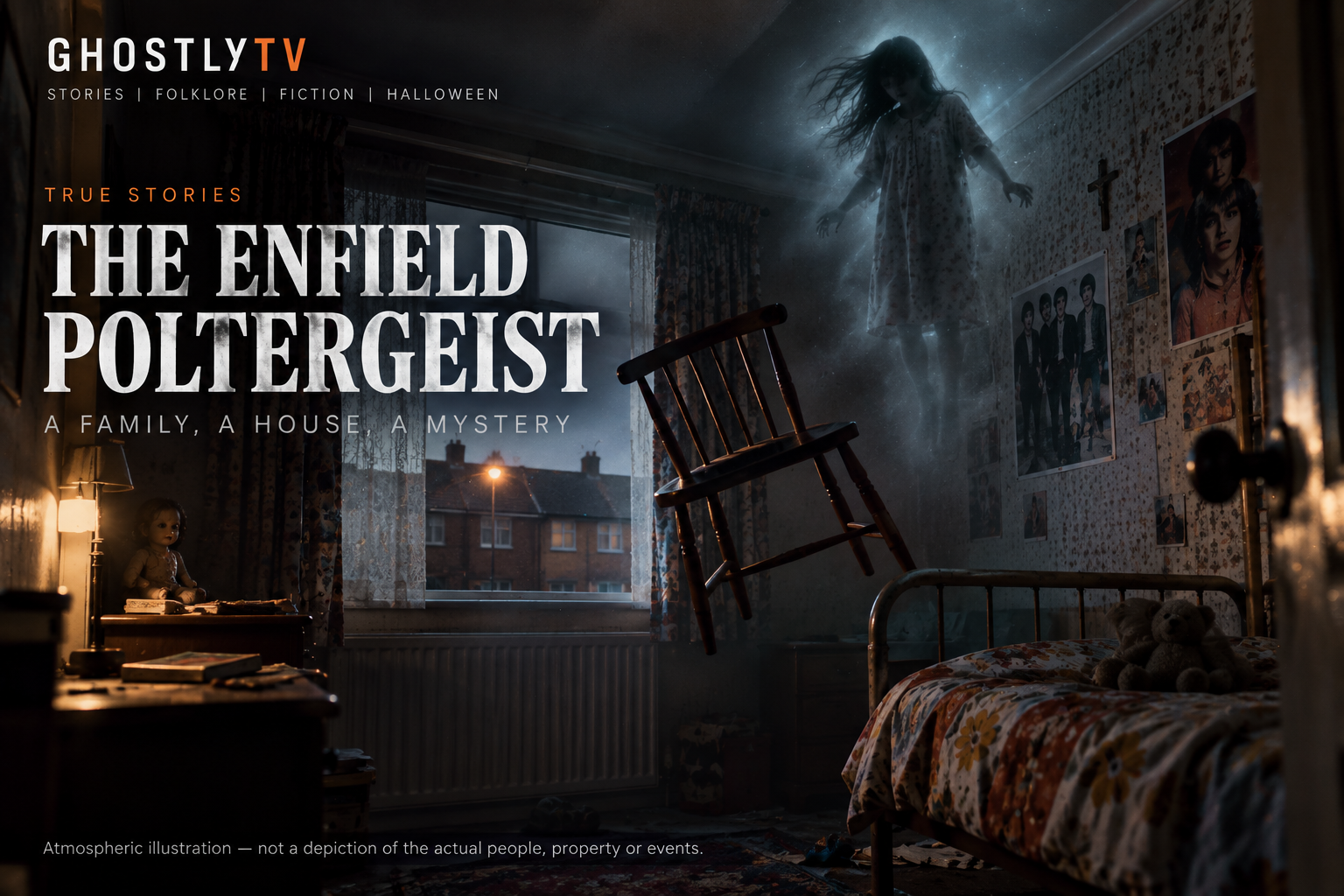
Strange events in Enfield
The story began in August 1977 at the Hodgson family's home in Enfield, North London.
Peggy Hodgson lived there with her children. According to accounts of the case, the children complained of strange movements and noises inside the house.
The reports soon became more dramatic. Furniture was said to move without anyone touching it, knocking sounds were heard around the property and objects were reportedly thrown across rooms.
The documented timeline
August 1977: The Hodgson family began reporting unexplained disturbances at their Enfield home.
1977: Police attended the property after being called to the house.
1977 onward: Paranormal investigators Maurice Grosse and Guy Lyon Playfair investigated the case.
Following months: Journalists, photographers and other investigators visited the house.
By 1979: Reports of disturbances had largely subsided.
The police visit
The family contacted neighbours and eventually the police. The attendance of police officers would later become one of the most frequently discussed parts of the Enfield story.
A police officer who attended reported seeing a chair move, although the officer did not claim to have established a supernatural cause.
That distinction is important: witnessing something unusual is not the same as proving why it happened.
The investigators arrive
Maurice Grosse, a member of the Society for Psychical Research, became closely involved with the family. He was later joined by writer and investigator Guy Lyon Playfair.
They spent considerable periods of time at the property and documented numerous alleged incidents.
Their investigation produced photographs and audio recordings that would become closely associated with the case.
The voice
The extraordinary events described below are claims from witnesses and investigators. Their supernatural explanation has never been established as fact.
Some of the strangest reports centred on Janet Hodgson, who was 11 when the disturbances began.
A deep, rough voice was reported to speak through Janet. Recordings of the voice were made, and investigators attempted to determine how it was being produced.
The voice was sometimes presented as belonging to a deceased former occupant of the house. This became one of the most famous elements of the Enfield story.
The famous photographs
Photographer Graham Morris captured a series of images showing Janet apparently airborne in her bedroom.
Supporters of the paranormal interpretation have described the photographs as evidence of levitation.
Sceptics have argued that the images instead show a child jumping from the bed. A still photograph cannot by itself establish which interpretation is correct.
Evidence of trickery
The case became more complicated because the children were caught producing some incidents themselves.
Janet later acknowledged that she and her sister had faked some events. Investigators who remained convinced that other incidents were genuine argued that occasional trickery did not explain everything they witnessed.
Critics reached a different conclusion and regarded the admitted fabrication as an important reason to doubt the wider paranormal account.
This disagreement remains at the centre of the Enfield case.
Believers and sceptics
Maurice Grosse and Guy Lyon Playfair believed that at least some of the phenomena they investigated could not be explained by ordinary causes.
Other investigators and sceptics challenged that conclusion, proposing explanations including practical jokes, misinterpretation and attention-seeking behaviour.
The result is not a case with one universally accepted explanation, but a collection of testimony, photographs, recordings and disputed incidents interpreted very differently by different observers.
From Enfield to Hollywood
The case remained well known among paranormal researchers for decades, but later television and film adaptations introduced the story to a much larger audience.
The Enfield case inspired books and television productions and was used as the basis for the 2016 horror film The Conjuring 2.
Dramatisations should not be treated as documentaries. They alter, combine or invent events for storytelling purposes.
What remains?
Enfield is fascinating partly because so many people became involved. Family members, neighbours, police, journalists, photographers and paranormal investigators all entered the story at different points.
There is documentation showing that an unusual and highly publicised series of events surrounded the Hodgson household. What that documentation cannot establish on its own is that those events had a paranormal cause.
For GhostlyTV, that uncertainty is part of the story rather than something to hide. The reports are real historical accounts. The poltergeist remains an interpretation of them.
A note about the location
The Enfield case involved a real family home. GhostlyTV discusses the location only where necessary to understand the historical story and does not provide directions or encourage visits to private residences. Please respect the privacy of current occupants and neighbours.