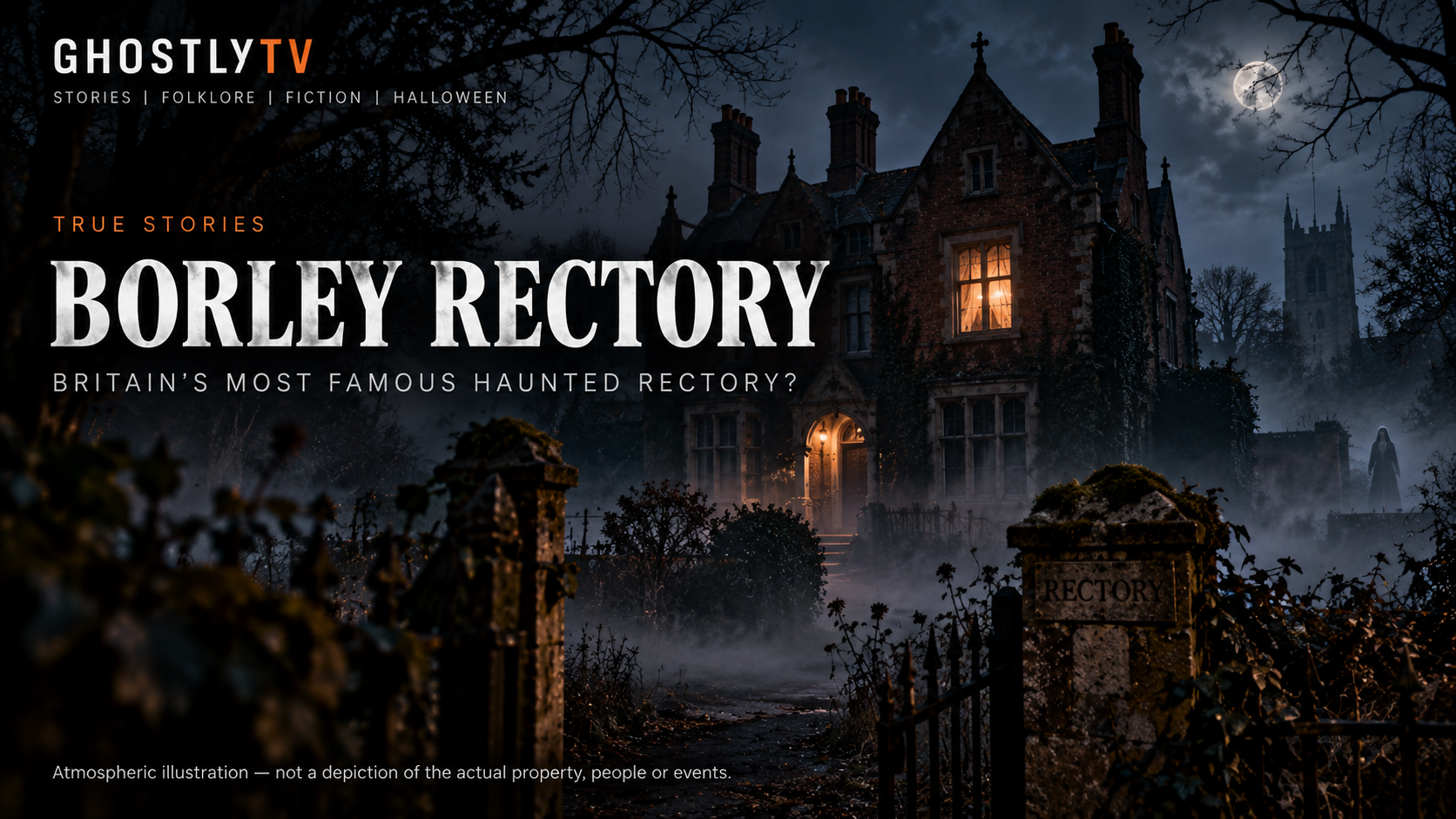
A rectory in rural Essex
Borley Rectory was built in the nineteenth century beside Borley's parish church, close to the Suffolk border in Essex. The large red-brick building became the home of the Reverend Henry Dawson Ellis Bull and his family.
Stories of unusual activity later became associated with both the rectory and its surroundings. Over time those stories grew into one of the best-known haunting legends in Britain.
The historical timeline
1860s: Borley Rectory was built for the Reverend Henry Bull and his family.
1928: The Reverend Eric Smith and his wife moved into the rectory.
1929: Paranormal researcher Harry Price visited after reports of unusual activity attracted press attention.
1930: The Reverend Lionel Foyster and his wife Marianne became residents.
1937: Harry Price rented the empty rectory and organised an investigation.
1939: The building was badly damaged by fire.
1944: The remains of Borley Rectory were demolished.
The legend of the nun
The following story forms part of the folklore surrounding Borley. It should not be treated as established historical fact.
Perhaps the most famous Borley legend concerns the ghost of a nun said to have walked through the grounds.
A romantic story eventually developed around the apparition: a nun from a nearby religious community was supposedly involved in a forbidden relationship with a monk connected to Borley.
Different versions of the legend describe a tragic ending, sometimes claiming that the nun was killed or imprisoned. Evidence supporting this story as an actual historical event has not been established.
Nevertheless, the image of the lonely nun walking through the grounds became inseparable from the Borley legend.
The Smith family
In 1928, the Reverend Eric Smith and his wife moved into the rectory.
Reports from this period included unexplained footsteps, ringing bells and other strange noises. The Smiths contacted the Daily Mirror, and newspaper interest brought the story to a much wider audience.
It was through this publicity that psychical researcher Harry Price became involved.
Harry Price arrives
Harry Price was already well known for investigating claims involving ghosts, mediums and other paranormal phenomena. He visited Borley in 1929.
Reports of unusual activity continued around the time of his visits, including alleged movement of objects and mysterious sounds.
Price's involvement would eventually make both him and the rectory famous, but his methods and conclusions later became subjects of considerable criticism.
The Foysters
Reverend Lionel Foyster and his wife Marianne moved into Borley Rectory in 1930.
Some of the most dramatic claims associated with the house date from their residence.
Reports included bells ringing without an obvious cause, objects appearing or disappearing and writing mysteriously appearing on walls.
Some messages were said to address Marianne directly, including pleas for help.
The origin of these messages remains disputed, and sceptical explanations have been proposed for incidents reported during this period.
An experiment inside the rectory
After the property became vacant, Harry Price rented Borley Rectory in 1937 and organised a longer investigation.
He recruited observers to stay in the building and record anything unusual they witnessed. Reports collected during this experiment included strange sounds, apparent movement and other unexplained occurrences.
Price later incorporated Borley's story into books that helped establish its reputation as an exceptionally haunted location.
The fire
Borley Rectory's physical story came to an end shortly afterwards.
In 1939, a fire badly damaged the building. The ruined structure remained standing for several years before finally being demolished in 1944.
Destruction of the rectory did not destroy the legend. If anything, the absence of the building helped turn Borley into an enduring piece of British ghost folklore.
Was Borley really haunted?
Harry Price's interpretation of Borley was strongly challenged after his investigations.
Researchers associated with the Society for Psychical Research later examined the case and criticised aspects of Price's work. Sceptics have argued that various incidents could be explained through natural causes, mistakes, exaggeration or deliberate trickery.
Supporters of the haunting story have argued that the number of reports, witnesses and incidents cannot all be dismissed so easily.
What remains certain is not the existence of a ghost, but the extraordinary cultural reputation that grew around the rectory.
Britain's most haunted house?
Borley Rectory has often been described as Britain's most haunted house. That description is a famous part of its reputation rather than a measurable historical fact.
The building itself has now been gone for more than eighty years, yet its stories remain remarkably persistent.
The spectral nun, mysterious bells, writing on walls, Harry Price's investigations and the arguments that followed have transformed a demolished Essex rectory into one of Britain's enduring supernatural legends.
GhostlyTV therefore treats Borley as both a historical place and a piece of paranormal folklore: the people and building existed, the investigations happened, but the supernatural explanation remains a claim rather than an established fact.
What remains today?
Borley Rectory itself no longer exists. Visitors should remember that the surrounding village contains homes, roads and property used by people today. GhostlyTV does not encourage trespassing or disturbance of local residents in pursuit of paranormal locations.